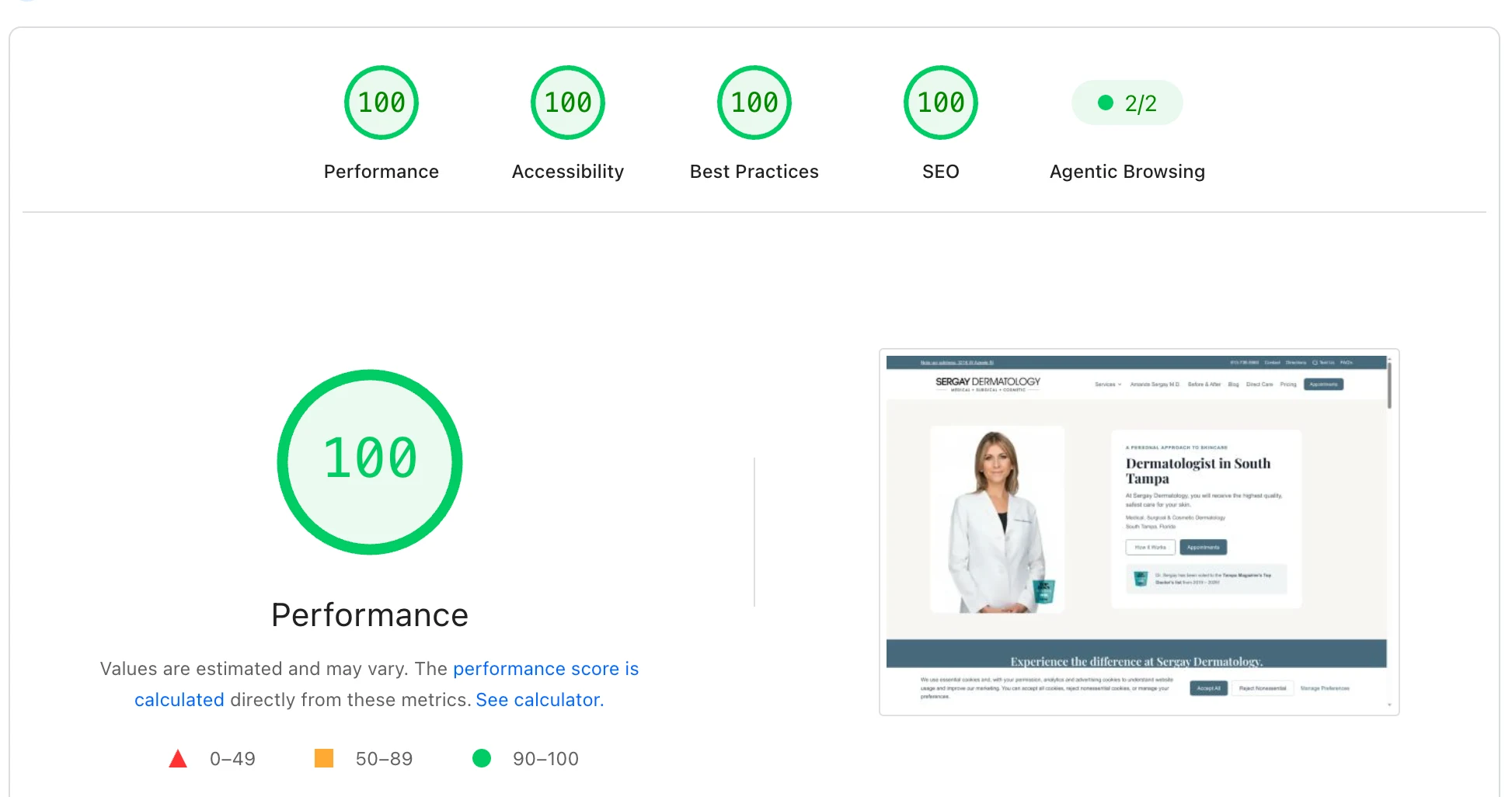
A Wix site rebuilt as a static Astro front end — 100 PageSpeed, double the monthly traffic and five times the Google Business Profile views.
Client
Sergay Dermatology
Industry
Healthcare
Platform
Astro
Year
2025
Wix to Astro MigrationStatic Site BuildLocal SEOGoogle Business ProfileAdWordsMonthly SEO AuditsLead Generation
The brief
/background/
Sergay Dermatology is a direct-care dermatology practice on West Azeele Street in South Tampa, run by board-certified dermatologist Dr. Amanda Sergay. The practice does not bill insurance, which changes what a website has to do: the cost of a visit is published in the main navigation, the reasoning behind the model gets its own page, and a patient is expected to arrive knowing what they will pay. It also competes for the same searches as hospital-owned groups with far larger budgets. The site was originally built on Wix, which meant template pages, stacked apps and a loading cost that no amount of tuning would remove. We moved the whole thing onto an Astro front end published as static pages, then took over the local search, the Google Business Profile and every AdWords campaign the practice runs. Since then monthly traffic has roughly doubled and Google Business Profile views are five times what they were.
Project goals
/objectives/
01
Get off Wix without losing what already ranked
The old site carried years of stacked apps and template weight, and no amount of tuning would have made it fast. A move to Astro meant carrying the content across and redirecting every old URL that already had search equity, rather than starting the rankings again from zero.
02
Score 100 on Google PageSpeed
Performance was treated as a requirement rather than a clean-up task: optimised image pipeline, no render-blocking assets, and every template tested against Google PageSpeed Insights before launch.
03
Own local search, not just the website
A page for every condition and treatment, three Tampa area pages, structured data throughout, and a Google Business Profile kept current — because the map result is seen before the site ever is. Local search and technical SEO are connected to real tools and audited every month rather than checked once at launch.
04
Explain a practice that does not take insurance
Most patients arrive expecting to hand over a card. The site had to say what a visit costs, why the practice works this way, and what a patient can do about reimbursement — before they rang the office to ask.
05
Turn local interest into booked appointments
We handle all of the practice's AdWords traffic — the account, the keywords, the landing pages and the budget — pointed at the highest-value treatments and measured on tracked calls and booking handoffs rather than clicks.
Our approach
/how we worked/
The practice arrived on Wix, not on a platform we could tune into shape. Years of stacked apps and template components had produced a site that was slow on a phone, awkward to publish to, and impossible to make fast without rebuilding it. So we moved it rather than patched it: the content, imagery and page structure were carried across to a new Astro front end published as static pages, every treatment, condition and location page kept its own address, and any old URL still carrying traffic was redirected to its replacement before the switch. The structure underneath is what makes it fast — the hero image is served first, everything below it is delivered as WebP at the size it is actually displayed, and only the few things that genuinely need to move (the navigation, the service tabs, the contact form) ship any JavaScript. Because the practice wanted local search rather than broad national traffic, every condition and treatment was mapped to its own page, structured data was added across the site, and the booking handoff into the practice scheduling system was wired into analytics so paid and organic visitors could be judged on appointments rather than sessions. The direct-care model was written out in full rather than implied, because it is the one thing that separates this practice from every other dermatologist in the same postcode. Alongside the build we took on the Google Business Profile — categories, services, photos, hours, posts and every review response — and then the advertising: we now plan, build and run all of the practice's AdWords campaigns, pointed at the treatment pages with real commercial intent rather than the homepage. Search Console, the profile and site analytics feed one monthly audit, which is the part that keeps the numbers moving: what has slipped, which page has decayed, which search terms are wasting budget, and what the next month's priorities are.
What we built
/in detail/
/01 — direct care/
The practice does not bill insurance, so the site has to say the price
A cash-pay practice opens with an unusual problem online: the visitor arrives expecting to hand over an insurance card, and the most useful thing the site can do is tell them they will not need one. Dr. Sergay runs the practice as direct care — published prices, appointments long enough for the question to be answered properly, and a detailed receipt a patient can submit for out-of-network reimbursement. None of that survives if the price only appears at the front desk, so the price became part of the navigation instead of a page nobody opens.
Pricing sits in the primary navigation beside Services and About, because without insurance contracts the price is part of the decision rather than a detail discovered at the desk.
A Direct Care page states the model plainly: no in-network plans, no surprise bills arriving after the visit, and a receipt detailed enough to submit to an insurer for potential reimbursement.
The four claims that carry the model — convenient, transparent, accessible, always an MD — are made together on the homepage, before a visitor reaches a single clinical page.
Appointment length is chosen by the patient for the problem they actually have, which is how the booking handoff was built rather than forcing everyone into one fixed slot.
/02 — the treatment library/
Every condition gets a page of its own, not a paragraph on a services page
Dermatology searches are specific. Nobody looks up “skin condition”; they look up actinic keratosis, or a mole that has changed, or hair thinning that started after an illness. The site was structured so each of those has an address — twenty-one general conditions, six cosmetic treatments, three surgical procedures and a paediatric set — all reachable from a navigation that opens into four plain categories rather than one long list nobody reads.
The menu splits into general, cosmetic, surgical and paediatric, so a patient can find a condition without first knowing which shelf a practice files it on.
Each condition and treatment carries its own page, its own photography and its own answer to the question that produced the visit, rather than one template with the heading swapped.
Three featured treatments — female hair loss, DermaV vascular laser and LaseMD Ultra — are surfaced on the homepage with the imagery and evidence to support them.
South, Central and North Tampa each have a page of their own, which is the honest way to compete on “dermatologist near me” without pretending to be a national brand.
/03 — the evidence/
Proof before the phone call: 34 results and eight straight years of Top Doctor
A cosmetic or surgical decision gets made with the eyes, and the practice already had the material: 34 before-and-after results across DermaV, LaseMD Ultra, hair loss and microneedling. They were organised into a gallery by treatment rather than scattered through the site, and the credentials a patient paying directly actually weighs — Top Doctors every year from 2019 to 2026, Super Doctors, the residency in New York — were given a permanent place instead of a line in the footer.
34 before-and-after results published by treatment, each labelled, so a patient can judge the work before booking a consultation.
Six patient reviews sit on the homepage with a link through to the full Google profile, so the social proof arrives before the contact form does.
Eight consecutive Top Doctor years are shown as badges together, which argues for the practice more convincingly than any line of copy claiming expertise.
The doctor page carries the whole chain — Emory, the University of Miami Miller School of Medicine, residency and chief residency at Mount Sinai St. Luke's-Roosevelt — because “who is treating me” is the first question a patient paying directly asks.
/04 — local search and paid/
Local search is the strategy, and the ad buy is held to appointments
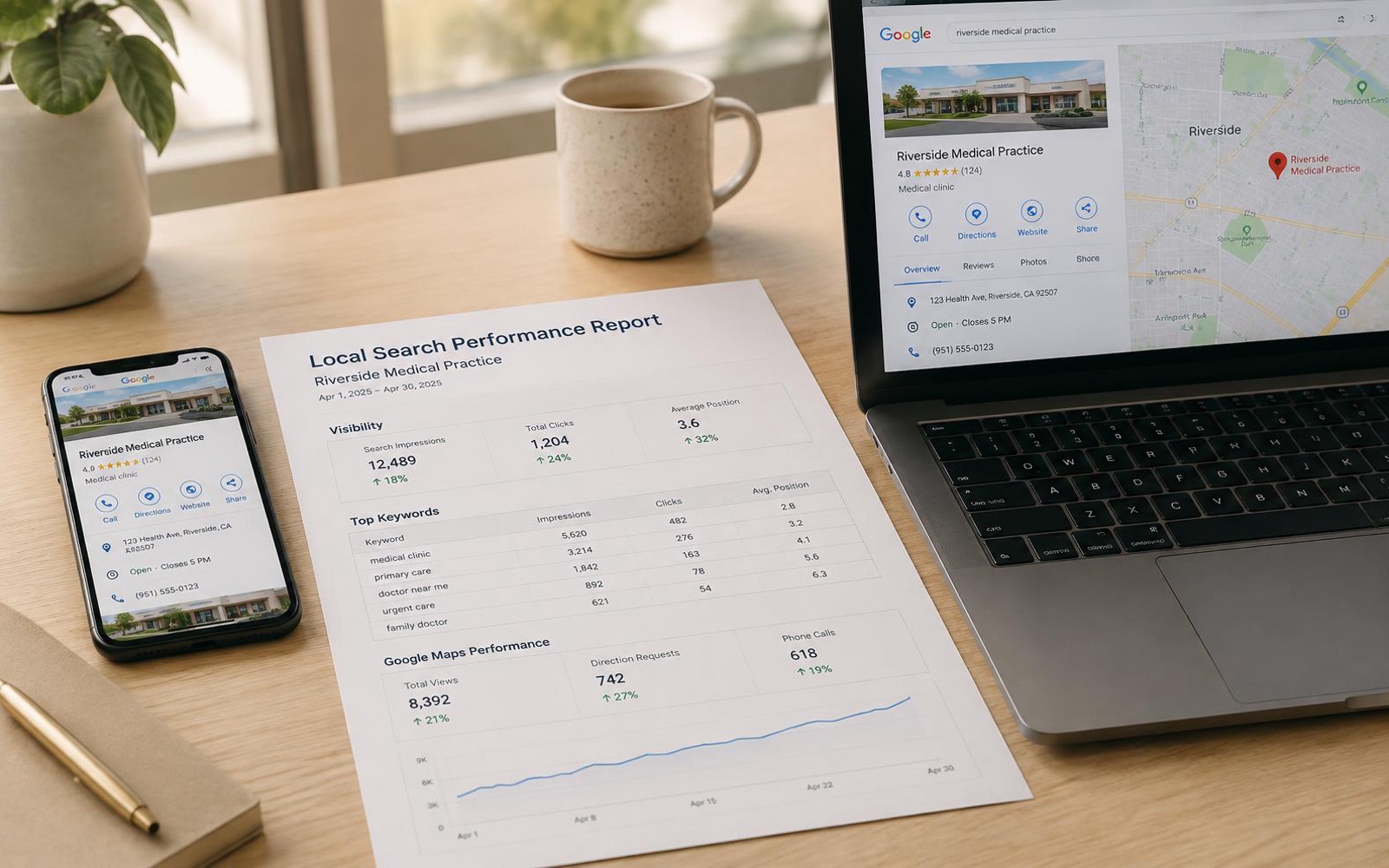
A dermatologist in South Tampa is found in two places: the map result and the page that follows it. Both had to be worked, and then kept worked. The profile carries the categories, services, hours and photos, and every review gets a reply rather than sitting there unanswered. The site carries a page per condition and a page per part of town, with the same name, address and phone number showing up identically everywhere the practice is listed — the unglamorous part that decides whether the map result appears at all. We then took on the whole AdWords account, and it is measured the way a practice actually cares about: a tracked phone call or a completed booking, not a click. The monthly audit is what stops any of it going stale, because local search decays quietly — a page that used to answer the question, a profile that lost its photos, a search term that started eating budget.
The Google Business Profile is treated as a second homepage: correct categories, every service listed, fresh photos, hours that hold on holidays, and a reply to every review rather than only the glowing ones.
Name, address and phone number kept identical across every listing that matters, which is the difference between appearing in the map result and being folded into it.
Search Console, the profile and site analytics are connected to real tools, not checked by eye, and reviewed in a written audit every month — what has decayed, what to fix first, what to leave alone.
We plan, build and run all of the practice's AdWords campaigns, from keyword and negative lists down to the landing page each ad points at.
Cosmetic searches and clinical searches are kept in separate campaigns, because someone pricing laser treatment and someone worried about a changing mole are two different decisions.
Budget follows whichever terms are producing tracked calls and booking handoffs, so the account is judged on patients rather than on impressions or click-through rate.
The results
/outcomes/
2×
Monthly page traffic since the move off Wix
5×
Google Business Profile views since taking over local search
100
PageSpeed across performance, accessibility, best practices and SEO
Monthly
technical and local search audit we run and act on
Have a project like this one?
Tell us what you are working on. We will come back with a straight answer on scope, timeline and budget.